As the name suggests it is a state of gonadal hypofunction due to anatomic or functional disorder in hypothalamic /pituitary compartments. This is the form of hypogonadism due to the problem in either pituitary or hypothalamus gland. The problem anywhere with the hypothalamic-pituitary-gonadal axis leads to reduced or no production of sex hormones like follicle stimulating hormone, luteinizing hormone in females and testosterone in males. Increased prevalence of hypogonadotropic hypogonadism (HH) has been observed among obese population and also among patients with type 2 diabetes.1,2
Symptoms
Delayed or no puberty is the main symptoms of HH. Associated symptoms are anosmia, in females, lack of breasts and menstrual periods, painful intercourse. Males with HH usually present with small testicles, erectile dysfunction, decreased libido, generalized weakness and decreased muscle strength.3
The diagnosis of male hypogonadism is based on symptoms and signs of androgen deficiency, together with consistently low serum testosterone levels. Serum testosterone levels follow a diurnal rhythm with values near 8 am being, on average, 30% higher than the trough levels later in the day.3 Diagnosis requires the determination of serum follicle stimulating hormone levels, luteinizing hormone levels and testosterone levels. MRI scans of the brain and sella should be considered.

Etiology
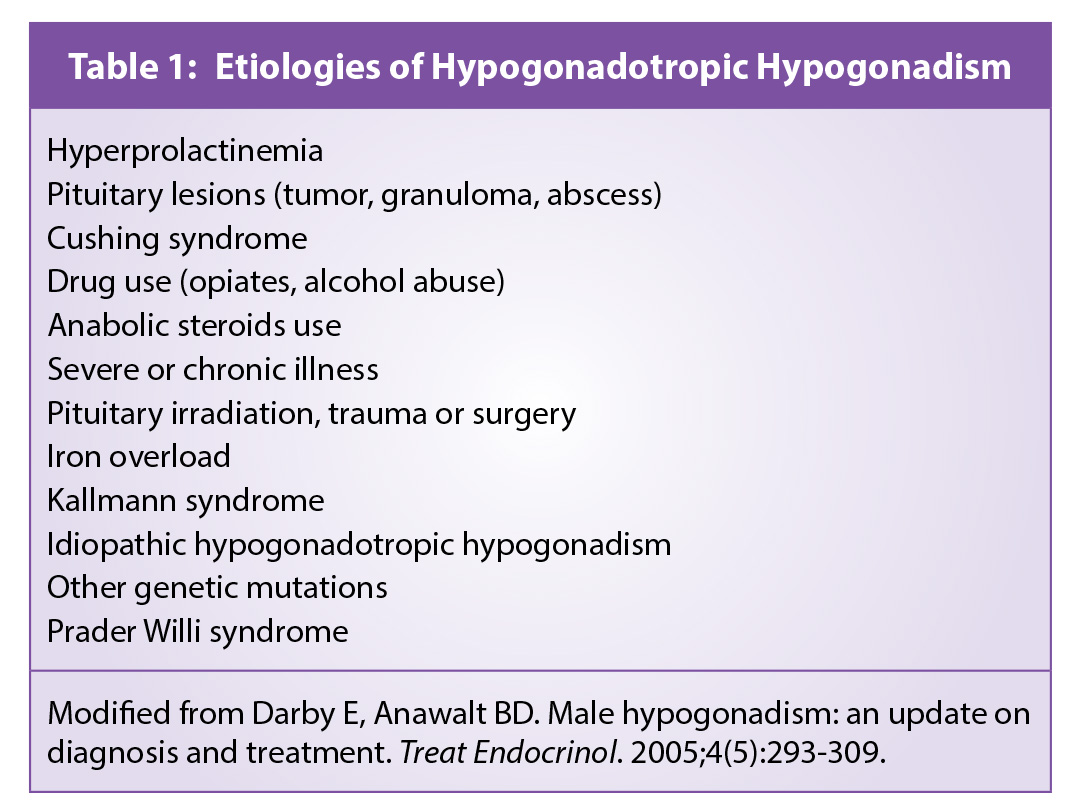
HH can be caused by congenital or acquired disorders.3
Congenital HH– Depending on the presence of intact sense of smell, this congenital HH is divided into two types: anosmic HH (Kallmann syndrome) and congenital normosmic isolated hypogonadotropic hypogonadism (idiopathic HH [IHH]). Kallman’s syndrome is a congenital hypogonadal syndrome with delayed puberty, anosmia, and midline facial defects resulting from impaired migration of GnRH. Idiopathic hypogonadotropic hypogonadism results in a similar clinical picture.
Acquired HH>- Acquired hypogonadotropic hypogonadism can be caused by drugs (e.g., sex steroids and gonadotropin releasing hormone analogues), infiltrative or infectious pituitary lesions, hyperprolactinemia, encephalic trauma, pituitary/brain radiation, exhausting exercise, and abusive alcohol or illicit drug intake.
Kallman syndrome
Kallman’s syndrome is a congenital hypogonadal syndrome with delayed puberty, anosmia, and midline facial defects resulting from impaired migration of GnRH. This can arise due to variety of mutations most important is KAL1 gene. This is known to be linked with autosomal genes, KAL1 (KS1), FGFR1 (KS2), PROKR2 (KS3), PROK2 (KS4), CHD7 (KS5), and FGF8 (KS6). The diagnosis of KS in adults is based on clinical findings, low or normal serum concentration of LH (luteinizing hormone) and FSH (follicle stimulating hormone) in the face of low circulating concentrations of sex steroids, normal pituitary and hypothalamus on MRI, and absence of other hypothalamic or pituitary abnormalities.4
Management of Kallman syndrome is mainly focused to induce and maintain secondary sex characteristics, gradually increasing the doses of gonadal steroids testosterone or hCG injections in males; estrogen and progesterone in females are administered. To stimulate spermatogenesis, gonadotropin therapy (hCG and human menopausal gonadotropins [hMG] or FSH or pulsatile GnRH therapy can be administered; to stimulate folliculogenesis, FSH or pulsatile GnRH therapy can be utilized. In vitro fertilization is an option if spermatogenesis is achieved but infertility persists.4
Idiopathic HH (IHH)
It is heterogenous disorder and also a treatable form of male infertility. IHH is sporadic or familial in occurrence and is more common in males. Clinically IHH presents similar to Kallman syndrome but only with exception, there is no alteration in olfactory functioning ( anosmia). The majority of IHH men respond well to induction of spermatogenesis with gonadotropins or pulsatile gonadotropin-releasing hormone.5
Functional HH (FHH)
Functional hypothalamic amenorrhea is a reversible form of gonadotropin releasing hormone (GnRH) deficiency commonly triggered by stressors such as excessive exercise, nutritional deficits, or psychological distress. Stressors such as weight loss, excessive exercise, eating disorders, and psychological distress suppress the hypothalamic–pituitary–gonadal axis by inhibiting hypothalamic pulsatile secretion of GnRH. Hypothalamic amenorrhea is associated with a spectrum of abnormal GnRH-secretion patterns, and administration of exogenous pulsatile GnRH can restore functionality of the hypothalamic–pituitary–gonadal axis.6 It was observed that in a male patient with FHH, levels of both testosterone (T) and serum estradiol increased dramatically after prolonged clomiphene medication and in response to human chorionic gonadotropin.7
Management
Regardless of the myriad of etiologies of HH , the underlying disturbance is low gonadotropin levels, and treatment can be affected through pharmacological replacements. Pharmacological management of HH includes drugs like, estrogens, LH, FSH, progesterone, human chorionic gonadotropins and human menopausal gonadotropins. Various studies have demonstrated their efficacy when used alone or in combination is successful treatment of HH. The choice of therapy is determined by whether goal of the treatment is to aid in fertility or not.
In women
Women with idiopathic HH are treated using sex steroids, gonadotropins and pulsatile GnRH administration. When the goal of the treatment is to achieve the development of secondary sexual characteristics estrogens initially with low doses should be opted. After 2 months when breast development has been optimized, replacement doses of estradiol and progesterone should be used. In women, where ovary stimulation is required FSH is the most widely used.3
In males
Treatment goal determines the choice of therapy. Androgen replacement can be considered where normal androgen levels, development of secondary sex characteristics and eugonadal state needs to be achieved. Androgen replacement is indicated for men who already have children or have no desire for children, and testosterone therapy is used to reverse the symptoms and signs of hypogonadism.3
In patients where infertility needs to be addressed, GnRH or gonadotropin therapies are the best options. Human chorionic gonadotropin (hCG) alone or in combination with follicle stimulating hormone (FSH), and human menopausal gonadotropin (hMG) are used for stimulating sperm production in such patients. In the rare cases of ‘fertile eunuchs’, who produce sufficient FSH but not LH, treatment with hCG alone may be sufficient to stimulate sperm production and achieve normal testosterone levels.
Pharmacotherapy
hCG
In males for stimulation of spermatogenesis administration of gonadotropins is necessary. hCG is used as the source of luteinizing hormone activity to stimulate testosterone secretion by Leydig cells, whereas hMG is used as the source of FSH. Many studies have reported that spermatogenesis can be maintained in IHH patients with hCG alone8 and other studies have demonstrated that spermatogenesis can even be induced with hCG alone in IHH patients, but the addition of hMG improved the sperm output in some patient9
Another study which evaluated relative importance of FSH for the maintenance of spermatogenesis in hypogonadotropic men, reported that once spermatogenesis is induced in patients with secondary hypogonadism by GnRH or hCG/hMG treatment, it can be maintained in most of the patients qualitatively by hCG alone, in the absence of FSH, for extended period.11
hCG+ FSH
Zacharin M conducted a study to evaluate the effect on spermatogenesis of adding follicle-stimulating hormone to hCG treatment protocols for adolescent/young adult males with hypogonadotropic hypogonadism, on 19 patients with HH. Patients were administered hCG alone or in combination with FSH for 6 to 9 months. All the patients treated with combination therapy demonstrated spermatogenesis when in patient treated with only hCG, 3 patients out of 9 patients demonstrated spermatogenesis. This study concludes that the addition of FSH to hCG treatment protocols in adolescent/young adult HH males results in normal testicular growth and may hasten induction of spermatogenesis.12 In women, exogenous gonadotropin use demonstrated 86% of live birth rate.13
Clomiphene citrate
Clomiphene citrate (CC) is an orally administered, nonsteroidal ovulatory drug typically used in female infertility management. This drug has estrogenic and antiestrogenic properties and increases the steroidogenesis. CC has been shown to increase T levels in both normal and impotent hypogonadal men probably reflecting the primacy of estrogen over T in the feedback regulation of male gonadal function. When compared to testosterone therapy, CC has the advantage as testosterone therapy can be associated with skin irritation, gynecomastia, nipple tenderness, testicular atrophy and decline in sperm counts.14
A study was conducted to assess the efficacy and safety of long-term clomiphene citrate therapy in symptomatic patients with hypogonadism. Serum T, estradiol and luteinizing hormone were measured in patients who were treated with CC for over 12 months. The 46 patients (mean age 44 years) had baseline serum testosterone (T) levels of 228 ng/dL. Follow-up T levels were 612 ng/dL at 1 year, 562 ng/dL at 2 years, and 582 ng/dL at 3 years (P < 0.001). Mean femoral neck and lumbar spine BD scores improved significantly. This study concluded that clomiphene citrate is an effective long-term therapy for hypogonadism in appropriate patients. The drug raises T levels substantially in addition to improving other manifestations of hypogonadism such as osteopenia/osteoporosis and ADAM( Androgen deficiency in the aging male) symptoms (Figure 1).15

FSH in treating oligozoospermia
FSH plays an important role in human reproduction. In males with HH, gonadotropins have shown to be effective. Even in oligozoospermic patients, treatment with FSH has shown restoration of normal spermatogenesis and spontaneous pregnancy.16
Gonadotropin therapy scores over testosterone therapy
A study was conducted to compare the efficacy of hormone treatment, hCG and hMG therapy on patients with HH. This study was conducted on 242 male patients. Patients were divided into 3 groups depending on the treatment administered. Group 1, 84 patients treated with hCG, Group 2, 74 patients treated with hCG+hMG, and Group 3, 84 patients treated with testosterone therapy. In total, 42 patients of group 1 (50.0%) and 56 of group 2 (75.7%) had their testicular volumes increased after 6-18 months treatment, from 2.0 ± 1.1 to 6.8 ± 3.2 mL and 2.1 ± 1.1 to 8.8 ± 3.9 mL, respectively (Figure 2 and 3). Only six patients of group 3 had their testicular volumes increased but no statistically significant. Among the patients with testes growth, 34 patients of group 1 and 48 patients of group 2 achieved spermatogenesis, and three of them made their wives pregnant naturally.17


Hence this study demonstrates that hCG therapy and hCG/hMG combination therapy both are effective in stimulating testes growth and spermatogenesis when compared to that of testosterone therapy and also the combination therapy had superior therapeutic effects.

Conclusion
Hypogonadotrophic hypogonadism commonly known as delayed puberty is rare disorder with increased prevalence in obese and type diabetes population. Its prevalence also increases with age. Symptoms of HH differ whether it is presents itself in childhood (before the onset of puberty) or after the onset of puberty. Congenital form of HH is known to be associated with genetic mutations. Patients with HH usually present with delayed or no onset of puberty, along with anosmia and reduced or no development of secondary sexual characteristics like no breast development, amenorrhoea in females and less facial hair, decreased libido, small testicles, etc in men. HH is one of the common causes of infertility which can be treated effectively. Gonadotrophins, hCG, hMG, Clomiphene citrate have demonstrated good positive results in the management of HH. Marked improvement in the spermatogenesis following gonadotropin therapy has made it one of the most reliable choice of therapy. Gonadotropin have also shown superior efficacy in the management of HH patients.
References
- Nemr R, Al-Katheer A, Echtay A, Almawi WY. High Prevalence of Hypogonadotropic Hypogonadism (HH) in Type 2 Diabetes. Endocr Rev. 2011; 32 (03_MeetingAbstracts): P2-534.
- Ippersiela V, Lepotb A, Grusonb D, et al. Hypogonadotropic hypogonadism among a population of obese men: Prevalence, risk factors and reversibility after weight loss induced by bariatric surgery. e-SPEN Journal. 2013;8(2):e37-e43.
- Fraietta R, Zylberstejn DS, Esteves SC. Hypogonadotropic Hypogonadism Revisited. Clinics. 2013;68(S1):81-88.
- Available at http://www.ncbi.nlm.nih.gov/books/NBK1334/. Accessed on 14/5/13.
- King TF, Hayes FJ. Long-term outcome of idiopathic hypogonadotropic hypogonadism. Curr Opin Endocrinol Diabetes Obes. 2012 Jun;19(3):204-10.
- Caronia LM, Martin C, Welt CK, Sykiotis GP. et al. A genetic basis for functional hypothalamic amenorrhea. N Engl J Med. 2011 Jan 20;364(3):215-25.
- Valenta LJ. A syndrome of functional hypogonadotropic hypogonadism and sterility in a male with elevated serum estradiol. Fertil Steril. 1977 Aug;28(8):881-4.
- Johnsen SG. Maintenance of spermatogenesis induced by hMG treatment by means of continuous hCG treatment in hypogonadotropic men. Acta Endocrinologica 1978;89: 763– 769.
- Vicari E, Mongioi A, Calogero AE, Moncada ML, Sidoti G, Polosa P, et al. Therapy with human chorionic gonadotropin alone induces spermatogenesis in men with isolated hypogonadotropic hypogonadism: long term follow-up. International Journal of Andrology. 1992;14: 320– 329.
- Marc A. Fritz, Leon Speroff. Clinical Gynecologic Endocrinology and Infertility. 8th edition. Lippincott and Williams. Philadelphia.
- Depenbusch M, von Eckardstein S, Simoni M, Nieschlag E. Maintenance of spermatogenesis in hypogonadotropic hypogonadal men with human chorionic gonadotropin alone. European Journal of Endocrinology.2002; 147: 617–624.
- Zacharin M, Sabin MA, Nair VV, Dagabdhao P. Addition of recombinant follicle-stimulating hormone to human chorionic gonadotropin treatment in adolescents and young adults with hypogonadotropic hypogonadism promotes normal testicular growth and may promote early spermatogenesis. Fertil Steril. 2012 Oct;98(4):836-42.
- Milsom S, Duggan K, O’sullivan S, Ogilvie M, Gunn AJ. Treatment of infertility with hypogonadotropic hypogonadism: 10-year experience in Auckland, New Zealand. Aust N Z J Obstet Gynaecol 2012 Jun;52(3):293-8.
- Da Ros CT, Averbeck MA. Twenty-five milligrams of clomiphene citrate presents positive effect on treatment of male testosterone deficiency – a prospective study. Int Braz J Urol. 2012; 38: 512-18.
- Moskovic DJ, Katz DJ, Akhavan A, Park K, Mulhall JP. Clomiphene citrate is safe and effective for long-term management of hypogonadism. BJU Int. 2012 Nov;110(10):1524-8.
- Foresta C, Selice R, Ferlin A, Garolla A. Recombinant FSH in the treatment of oligozoospermia. Expert Opin Biol Ther. 2009 May;9(5):659-66.
- Yang L, Zhang SX, Dong Q, Xiong ZB, Li X. Application of hormonal treatment in hypogonadotropic hypogonadism: more than ten years experience. Int Urol Nephrol. 2012 Apr;44(2):393-9.